



On August 14, 2020, at the end of the day, the Gulf Livestock 1 and her crew of 43 sailors left Napier on the east coast of New Zealand’s North Island. The livestock carrier was loaded with 5,867 cows bound for China. The ship was due to reach Tangshan, in Hebei province, after a 17-day journey. On the night of September 2, she was southwest of Japan. She sent out a distress call at 1:40 a.m. local time. She was 185 km west of Amami Oshima Island. One of her engines had failed. She was caught in Typhoon Maysak, a category 4 storm. The winds blew against the ship, which offered a fatal surface to the wind. The Gulf Livestock 1 capsized and sank. At the end of the day, Japanese coastguard aircraft spotted an empty lifeboat near the ship’s last known location and, in the water, a survivor. Sareno Edvarodo, 45, the Filipino-born second-in-command, was rescued by one of the 4 ships taking part in the search. Another sailor was recovered unconscious and pronounced dead at the hospital. 37 Filipino sailors, 2 New Zealanders, one Singaporean and one Australian are missing. The cows were swallowed up, but bodies were spotted on the surface of the sea and it is possible that carcasses will wash up on shore in the coming weeks and months.
Since her conversion into a livestock carrier, the condition of the former container ship had been constantly deteriorating. However, the ports of Australia, Brazil, Colombia, Spain, Egypt, Jordan and Indonesia where she was inspected hardly bothered her. Only the Australian port of Broome detained her for 3 days in May 2019 for non-compliance with ISM (International Safety Management) procedures. The company responsible for this shortcoming was Mar Consult Schiffahrt (GmbH & Co) KG, based in Hamburg, Germany.
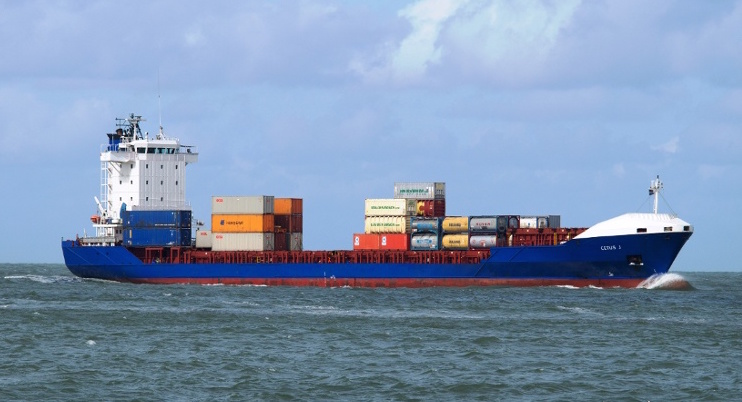
Container ship, March 2014, Rotterdam (The Netherlands). © Frank Katzer
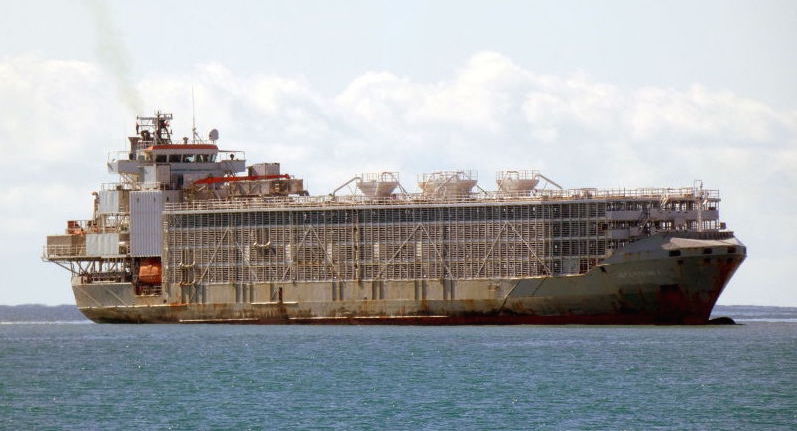
Livestock carrier, August 2020, Napier (New Zealand). © Tony des Landes
The Gulf Livestock 1 ended her career tragically, after several warning signs in recent years. In 2018, while she was sailing under the name Rameh, Turkish veterinary services detected anthrax contamination in livestock upon the arrival of a shipment from Brazil. In September 2018, she anchored off Cesme (Türkiye). She was immobilised due to engine failure. The necessary spare parts were not available on board. Repair crews were reluctant to intervene for fear that traces of anthrax were still present. In July 2020, following another mechanical failure, the Gulf Livestock 1 was rescued by the Philippine Navy. She had already resumed her traffic. Too quickly.
This latest tragedy once again highlights the cruelty of live cattle transport by sea and the dilapidated state of the vessels used to transport sheep, cows, other cattle and horses across the world’s oceans (*).
Gulf Livestock 1 (ex-Rameh, ex-Cetus J, ex-Dana Hollandia, ex-Maersk Waterford, ex-Cetus J). IMO 9262883. Length 134.06 m. Panamanian flag. Classification society Bureau Veritas. Built in 2002 in Berne (Germany) by Roland Hegemann. Former container ship with a capacity of 630 TEU converted in 2015 for the transport of live cattle. Owner Gulf Navigation Livestock 1 registered in Panama c/o Hijazi & Ghosheh Co (Jordan). Detained in 2019 in Broome (Australia).
(*) See on the subject of the maritime transport of live cattle:
– End of the cruise for the sheep: “Shipbreaking” #28, p. 53-55, July 2012.
– Dumping of cow corpses by the Abou Karim IV: “Shipbreaking” #34 p. 1-2, February 2014.
– Ezadeen, the livestock and migrant carrier, January 2, 2015
– From cattle carrier to human trafficking: “Shipbreaking” #38, p. 17, February 2015.
– Sinking of the Haidar in Barcarena (Brazil), October 2015: “Shipbreaking” #41 p. 6-7; “Shipbreaking” #43 p. 2-3; “Shipbreaking” #49 p. 6.
– Sète, le port qui ne pense pas bête (Sète, the port that thinks beastly), November 26, 2018 (only in French)
– Midia, Roumanie: noyade de plus de 14.000 moutons (Midia, Romania: more than 14,000 sheep drowned), November 29, 2019.
– S.O.C. Save Our Cattle, “Shipbreaking” #58 p. 5-6, February 2020.
 Imprimer cet article