



Press release CITES CoP20 n°7
Enhanced protection for dorcas gazelles (Gazella dorcas)
The proposal by Benin, Burkina Faso, Mali, Mauritania, Niger, Nigeria, Senegal, Sudan and Tunisia to list dorcas gazelles in Appendix II was accepted by consensus. Djibouti, Algeria, Morocco and Israel, which are also range States, expressed their support during the debates, as did Togo, Gabon, Brazil, Panama and the United Kingdom. No country spoke against the proposal. There are now fewer than 10,000 dorcas gazelles in their vast original range, which stretches from Mauritania in the west to Sudan in the east. They are believed to be extinct in Senegal. They are victims of motorised hunting and the pet trade. The main predator and importer countries are the United Arab Emirates, Qatar and Saudi Arabia. Dorcas gazelles have not been able to withstand intensive hunting or capture, even though they are resistant to drought. They can satisfy their water needs by grazing on plants with a high-water content. Trophies, meat, skulls, skins, skeletons and live individuals are traded internationally, both legally and illegally.
Between 2013 and 2022, “On the Trail” reported poaching by emirs from Bahrain, Qatar, Saudi Arabia and the United Arab Emirates using 4x4s and quad bikes, and by poachers, in Algeria, Niger and Tunisia.
The dorcas gazelle should in fact be listed in Appendix I, but Appendix II will help to stem the haemorrhage.
 Gazella dorcas © Jukka Jantunen
Threats to saigas (Saiga tatarica)
Saiga antelopes were listed in Appendix II of CITES in 1995.
This listing was tightened in 2019 with a zero export quota, which effectively amounted to a ban on international trade.
Kazakhstan wanted to be allowed to export horns from “its” saigas again.
Following discussions with the European Union, the United Kingdom and the United States of America, Kazakhstan proposed an amendment limiting exports to 30 tonnes of horns from government stocks (10 tonnes/year until CoP21) over the next 3 years, with various control measures similar to those required for “one-off sales” of elephant ivory. These sales had led to a resurgence of elephant poaching and ivory smuggling. Kazakhstan’s stocks were built up from seizures, natural or accidental deaths, and legal culls to limit overpopulation and damage to crops (see about this “On the Trail” n°42, pp. 50-51, ref. 13, and “The mishmash of the saiga antelopes”, n°44 p.68 ref.18). Kazakhstan estimates them at more than 62,000 horns, or 12 tonnes, based on an average weight of 200 grams per horn.
The amended proposal received overwhelming support (Algeria on behalf of the “African group”, Kuwait, Kyrgyzstan, Tajikistan, Qatar, Brazil, Mexico, Colombia, Azerbaijan, Uzbekistan, Russia, Singapore, Namibia, Japan and China in particular). China was enthusiastic and stated that “the sustainable use of this species contributes to its conservation”.
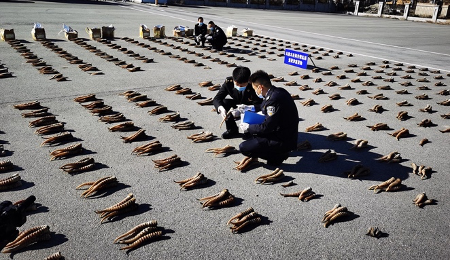 Seizure of 2,099 horns in mainland China in March 2021 © Legal Daily
The only country to have defied this fairy tale is Mongolia. It has highlighted the impossibility for customs officers to distinguish between the horns of saigas living in Mongolia and those of saigas living in Kazakhstan, and the risk that this resumption of trade will stimulate the still very strong demand, increasing poaching and illegal trade. The Mongolian delegate also stated a harsh truth: 30 tonnes of horns equates to 75,000 male saigas.
Despite the steamroller of States in favour of the proposal, supported by TRAFFIC and the IUCN, Mongolia did not give in and called for a vote. 111 countries voted in favour of Kazakhstan’s amended proposal. Only 7 countries voted against: Bangladesh, Comoros, Guatemala, Montenegro, Uruguay, Fiji and Mongolia.
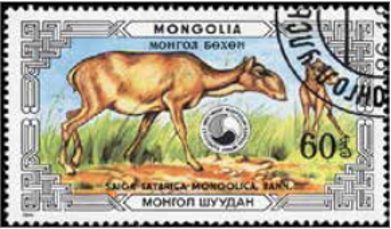
Between 2013 and 2025, “On the Trail” recorded cases of poaching, trafficking and seizures of saiga horns in mainland China, Hong Kong, Kazakhstan, Kyrgyzstan, Mongolia, Viet Nam, Türkiye, the Czech Republic, Russia and Ukraine. The total number of seizures amounts to approximately 86,000 horns. A horn sells for up to 150 US$ in China. Only male saiga antelopes have horns. Saiga antelopes are victims of devastating epizootics attributed to foot-and-mouth disease and pathogenic bacteria of the Pasteurella type. The last outbreak occurred in 2015, killing approximately 200,000 saiga antelopes. Medicines made from saiga horns are reputed in Asia to have invigorating and aphrodisiac properties.
Sacred union for united giraffes
The proposal by Namibia, South Africa, Tanzania and Zimbabwe to remove giraffe populations in Angola, Malawi, Mozambique, South Africa, Botswana, Eswatini, Namibia and Zimbabwe from Appendix II was rejected. These last 5 countries had expressed reservations about the listing of Giraffa camelopardalis in Appendix II, which was decided at CoP18 in August 2019 in Geneva, Switzerland. According to Charlotte Nithart, Robin des Bois’ representative at both CoP18 and CoP20, “it was time for the international community to react.” “Giraffes are collateral victims of the elephant extinction. Their bones are more and more used as an ivory substitute. They are also a prime victim for those who want to take home a bit of dead Africa as well as for zoos.”
The proposing countries pointed out that “recent taxonomic revisions have reclassified Giraffa camelopardalis into four distinct species, including the southern giraffe (Giraffa giraffa), which itself comprises two subspecies: the South African giraffe (G. g.giraffa) and the Angolan giraffe (G. g. angolensis)”, and that this new taxonomic division was recognised by the GOSG (IUCN Giraffe and Okapi Specialist Group) in August 2025. Given the alleged good health of the South African giraffe and Angolan giraffe populations, the proposing countries therefore wished to have these two subspecies removed from Appendix II.
Senegal and Benin emphasised that different listings for different countries could increase the risk of fraud and smuggling of giraffe bones and other parts. For example, “how can you tell the difference between a giraffe femur from Namibia and one from Kenya?” They were supported in this view by Niger, Rwanda and Kenya. Kenya pointed out that giraffe meat is also subject to cross-border trade.
Before the secret ballot, Botswana, Japan, Malawi, the United Arab Emirates, the United States of America and Zambia expressed their support for the proposal. The European Union pointed out that it had supported the listing of giraffes in Appendix II and that the bones were used in particular for cutlery. The proposal was rejected by 49 votes in favour, 48 against and 38 abstentions, including the European Union.
Between 2014 and 2025, “On the Trail” noted a surge in giraffe poaching, seizures of bones, skulls, skins, tails, trophies, stuffed specimens, meat, and trafficking in accessories in South Africa, Cameroon, Kenya, Mali, Mozambique, Namibia, Uganda, the Democratic Republic of the Congo, Tanzania, Zambia, Zimbabwe, Viet Nam, the United States of America, Brazil, Ireland, Norway, the United Kingdom, Sweden, France, the Netherlands, Spain, Italy and New Zealand. As early as 2015, “On the Trail” n°7 raised the alarm about new pressure on giraffe populations. “After the rhino horn that cures cancer, the giraffe bone marrow that cures AIDS… The national symbol of Tanzania is under threat. The elegant savannah pin-up has feet of clay.” Among the giraffe by-products and accessories are giraffe horn bottle openers, knives with bone handles, lamps with bone bases, fly swatters made from tails, boots made from skin and even a table with giraffe leg legs.
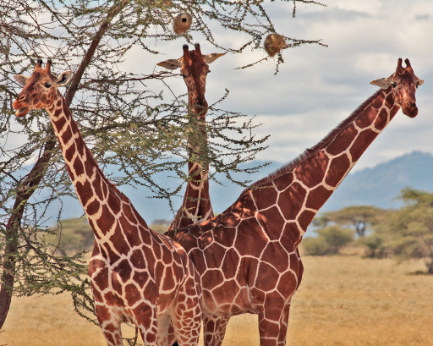 Giraffa camelopardalis reticulata © Gerold Morrison
To the rescue of the okapi (Okapia johnstoni)
The Democratic Republic of the Congo, the only country hosting okapis, requested that the species be listed in Appendix I. It received support from Cameroon, Benin, Bahrain, Benin, Cameroon, Zimbabwe, Rwanda, the Central African Republic, Brazil, the Dominican Republic, Bolivia, the Comoros, the United States of America, New Zealand and China. Only Japan spoke out against the proposal. As it was in a clear minority, it did not request a vote. The proposal was therefore accepted by consensus.
In the north-east of the Democratic Republic of the Congo, the Okapi Wildlife Reserve, a UNESCO World Heritage Site, covers 14,000 km2, or one fifth of the Ituri Forest. It is home to elephants, chimpanzees and several thousand okapis in an environment disrupted by civil war, military mines and illegal logging and mining.
Between 2016 and 2024, “On the Trail” recorded seizures of meat, skin and fat in the Democratic Republic of the Congo, the Republic of the Congo and Uganda. As a reminder, there are no okapis in the latter two countries.
According to the NGO Conserv Congo, an okapi skin sells for around 10,000 US$ when it leaves the Democratic Republic of the Congo. Soldiers from MONUSCO (United Nations Organisation Stabilisation Mission in the Democratic Republic of the Congo) return to their countries with vials of okapi fat, which is believed to have restorative and healing properties. A litre sells for up to 50,000 US$.
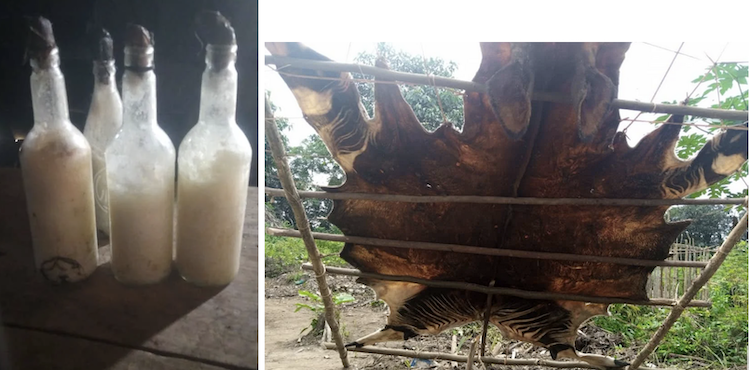 Fat and skin of okapi © Okapi Conservation Project
Suspense for the striped hyena (Hyaena hyaena)
Tajikistan’s proposal to list striped hyenas in Appendix I has been rejected for the time being. This is the first time that Tajikistan, a member country since 2016, has proposed listing a species in the CITES Appendices.
The proposal received support from most range countries: Algeria “on behalf of the entire African group”, Tunisia, Armenia, Türkiye, Uzbekistan, Djibouti, Iran, Lebanon and Nepal. Kuwait and Somalia, where striped hyenas may still be present, also supported Tajikistan. Russia and Kazakhstan also expressed their support.
Djibouti pointed out that the striped hyena is persecuted because of old beliefs, and Lebanon emphasised that it acts as a natural scavenger, like the vulture.
The European Union, while recognising that striped hyena populations are declining, did not support the proposal due to a lack of recent knowledge on the status of the populations.
Tanzania was the only country in the range to oppose the proposal. It demanded a vote. The proposal failed because of the European Union’s vote. It voted against. Results: 75 votes in favour, 47 against and 13 abstentions. A two-thirds majority was required, i.e. 90 votes in favour.
All is not lost, however, as Tajikistan has announced that it may request a review of its proposal during the plenary sessions to be held on the last two days of this Conference of the Parties. Perhaps on that occasion, the European Union will change its position.
Between 2015 and 2025, “On the Trail” recorded cases of poaching, lynching and seizures of striped hyena bones in Algeria, Kenya, Morocco, Nigeria, India, Iran, Pakistan, Israel, Jordan and Lebanon. Hyenas are subject to all kinds of hassles. They are victims of bush fires, of reprisals by cattle farmers, of looks and smell discrimination and of an insistent rumour: in alternative or last resort medicines, their brains are believed to have magical properties.
 Seizure of a striped hyena skeleton in September 2021 in India, “On the Trail” n°34 p.86 ref.8
© Ministry of Environment, Forest and Climate Change (Inde)
See all Robin des Bois publications on CITES CoP20 in Uzbekistan
 Imprimer cet article