




Sanctions against Russia: will they dare?
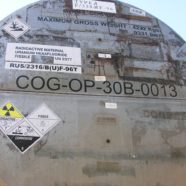
Cancellation of the Franco-Russian contract for the conversion and enrichment of reprocessed uranium (TRU)
Each year, the reprocessing plant of spent fuel at La Hague peninsula in Normandy near Cherbourg produces about 1,000 metric tons of RU (reprocessed uranium) from spent fuel coming from French nuclear power plants. The RU stock is currently about 27,000 tons. The reprocessing of RU to make “new” fuel cannot be done in France. The only plant for converting RU into Enriched Reprocessed Uranium (ERU) is located in Russia. The circular economy of French nuclear power goes through Tomsk in Siberia.
In search of a solution for the contaminated water of Fukushima
Earthquake and Tsunami in Japan, March 11, 2011 – Press release n°17
It is said that the Japanese government is about to authorize the release of radioactive water from Fukushima Daiichi into coastal waters and the ecosystem of the Pacific Ocean. Tepco, operator of the plant that crashed on March 11, 2011, the Ministry of Economy, Trade and Industry and the International Atomic Energy Agency are promoting this option. This voluntary pollution would set a precedent that could be brought up again in the Atlantic Ocean in the event of a major accident at a nuclear power plant or at the La Hague atomic complex in Normandy.
Soon Kim will pick up the MOX in his binoculars
Within a few days, unless an accident occurs, the Pacific Egret will enter the North Korean missile influence area. The Pacific Egret carries 8 tons of MOX, a nuclear fuel made in France containing 8 to 10% of plutonium mixed with enriched uranium. This civil bomb left the French port of Cherbourg on July 5, 2017.
After having sailed down the Atlantic Ocean, passed off South Africa, crossed the Indian Ocean and the Pacific Ocean, the MOX is expected to be unloaded in the small private port of the Japanese nuclear power plant in Takahama, facing North Korea.
BBC Shanghai, a radioactive risk for Asia
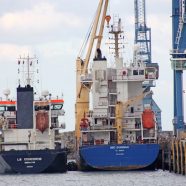
October 2015. The BBC Shanghai, owned by Germany-based Briese Schiffahrts GmbH & Co KG, is making the headlines of the world’s maritime shipping news. She has been selected by the French nuclear operator AREVA to ship to Australia radioactive waste reprocessed in Normandy at the La Hague plant. However, the ship had a bad record regarding technical deficiencies as attested by the maritime authorities of all continents; she had been detained three times in Bilbao (Spain), Gladstone (Australia) and in March 2015 in Honolulu (Hawaii, United States). The international mobilization to demand the chartering of a safe ship will do nothing about it, the BBC Shanghai loads 25 tons of radioactive waste and leaves Cherbourg (France) on October 15 for Port Kembla near Sydney. Indonesia has denied her access to its waters. She arrived at Port Kembla on December 5 after a 25,000 km trip.
MOX : Areva’s Slip-Up and heavy sleep
Areva, a modern day pirate, keeps up maritime expeditions carrying nuclear fuels and fissile materials. The Pacific Egret is a military ship painted in blue. She disconnected her AIS on the 13th of June, 2017. An AIS (Automatic Identification System) allows one to know the position and route of a ship and is essential for maritime safety. There are no surface ships of the French Navy that currently transport cargo and a weapon as formidable as that of The Pacific Egret. Several options are possible for the seagoing voyage from Cherbourg to Japan. Once used in the bygone days of Noriega for sensitive nuclear material, the Panama Canal is no more a viable option for political reasons. Crossing the South Atlantic, Indian Ocean, and South Pacific is now the most classic way to go. With the agreement of Vladimir Putin, the Arctic North-East passage off Siberia cannot be completely excluded as an option either.
Moxquitue
Next week, MOX fuel will be loaded in Cherbourg onto the Pacific Egret or onto the Pacific Heron with the destination of the Takahama nuclear plant in Japan. MOX contains 10% plutonium and 90% uranium.
This voyage of dangerous fissile materials across the worldwide oceans causes tension and poses risks all along the track. The point of the refuge port in case of damage or fire has yet to be solved. The ability of the modest ships from Pacific Nuclear Transport Ltd to resist cyclones, tsunamis, and North Korean missiles has not been demonstrated either.