


70th International Whaling Commission
Press release n°4
The 70th International Whaling Commission meeting concluded today.
The resolution on “cetacean strandings as a cross-cutting priority of the IWC”, submitted by the United Kingdom and Ireland on behalf of the countries of the European Union, was adopted by consensus (see “Tomb-beaches”, September 29, 2026).
The resolution on vessel strikes, submitted by Ireland on behalf of the countries of the European Union, was adopted by a vote. Only Antigua and Barbuda, India, the Marshall Islands, Morocco and the United States of America voted against it. Yet the US coastline is a death road for whales (see “The blue whale between Scylla and Charybdis”, October 1st, 2026).
The resolution on “the global trade in fish maw and incidental catches of threatened cetaceans” was adopted by a vote. Only South Korea, Nauru, Norway and the United States voted against it. Fish maws, or swim bladders, or gas bladders, enable most bony fish to regulate their swimming depth. In Chinese cuisine, they are one of the four “sea delicacies”, alongside sea cucumbers, abalones and shark fins. Dried swim bladders from totoabas, fish endemic to the Sea of Cortez, are the most sought-after and rarest. They fetch the astronomical price of 70,000 € per kilogram. The global market for swim bladders is worth 250 million euros per year. It is expanding uncontrollably. Demand, fuelled by claims of regenerative and aphrodisiac properties that, all in all, supposedly guarantee eternal youth for the skin and body, now extends to at least thirty species across the world’s oceans. Those most targeted belong to the Sciaenidae family, such as totoabas, weakfish and croakers.
Gillnets, trammel nets and other fishing gear used by the fisheries also catch small cetaceans such as the vaquitas, who are at imminent risk of extinction, the Guiana dolphins, finless porpoises, Irrawaddy dolphins, Indo-Pacific, Atlantic, Australian and Indian Ocean humpback dolphins. In particular, the resolution encourages Member States to monitor and regulate the trade in fish species that are caught for their maw, with the aim of reducing cetacean bycatch. The most effective measure would be the listing of certain species in the Appendices of CITES (Convention on International Trade in Endangered Species of Wild Fauna and Flora). For that matter, in response to the surge in trafficking of acoupa weakfish swim bladders in Guianese waters since 2017 (1), Robin des Bois has called on the French government to propose the listing of the species in Appendix II (control of the trade), and this was included in the 2024–2030 National Sea and Coastline Strategy. This commitment has not yet been followed up.
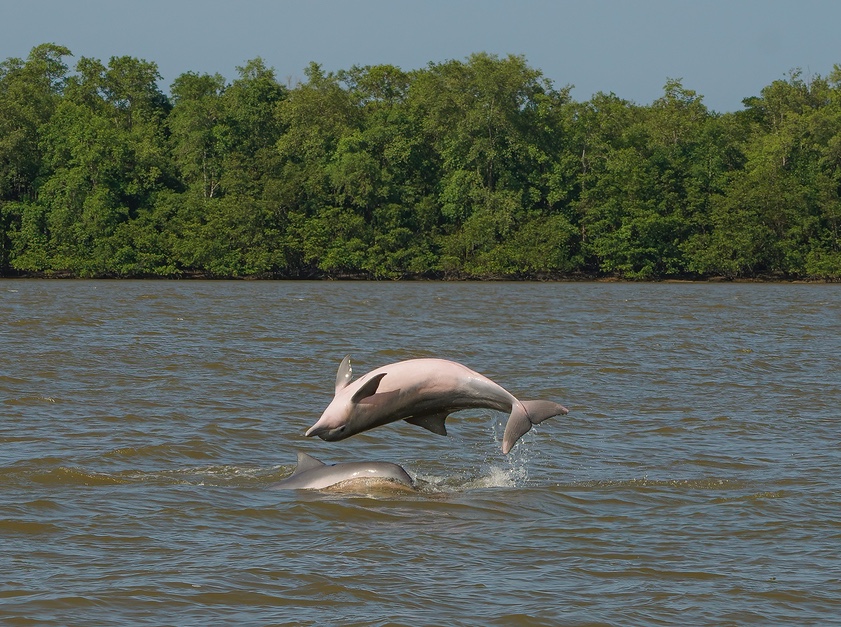 Guiana dolphins © Jap Smits
The International Whaling Commission will continue its work on the positive contributions of whales to ecosystems (see “Whales at the service of oceans”, September 28, 2026).
The proposal to establish a whale sanctuary in the South Atlantic, put forward by Argentina, Brazil and Uruguay with the support of Gabon, was rejected by 39 votes in favour, 18 against and 3 abstentions (see the last two paragraphs of “Tomb-beaches”, September 29, 2026). Three-quarters of the votes cast were required for the proposal to succeed, i.e. 43 votes in favour. South Africa, which would be within the sanctuary’s boundaries, the United States, the countries of the European Union and all South American countries voted in favour, with the exception of Suriname. Five African countries bordering the Atlantic Ocean voted against the proposal (Benin, Côte d’Ivoire, Mauritania, Morocco and Senegal), even though they are not included in the proposed sanctuary. Côte d’Ivoire and Senegal are in favour of “the sustainable use of marine living resources, including whales”.
Brazil has been calling for the creation of this sanctuary since 1998 and first submitted it to a vote at the IWC in 2001. Brazil has announced its intention to resubmit its proposal until it is accepted. The big day could come at the 71st plenary meeting of the IWC, if it is held as planned in South Africa.
Countries present in Hobart:
The International Whaling Commission has 89 Member States. Türkiye joined the Commission in 2025. Today, the final day of the Commission’s meeting, 60 countries were present in Hobart and had voting rights (compared with 47 on the first day): South Africa, Germany, Antigua and Barbuda, Argentina, Australia, Austria, Belgium, Benin, Brazil, Bulgaria, Cambodia, Chile, Colombia, South Korea, Costa Rica, Côte d’Ivoire, Croatia, Cyprus, Denmark, Spain, the United States of America, France, Grenada, Hungary, Iceland, India, Ireland, Italy, Laos, Lithuania, the Marshall Islands, Morocco, Mauritania, Mexico, Monaco, Nauru (Naoero), Nicaragua, New Zealand, Norway, Palau, Panama, the Netherlands, Peru, Poland, Portugal, Dominican Republic, Czech Republic, United Kingdom, Saint Kitts and Nevis, Saint Lucia, Saint Vincent, Senegal, Slovakia, Slovenia, Suriname, Sweden, Switzerland, Türkiye, Tuvalu, Uruguay.
(1) See “On the Trail” n°19, p. 12.
https://robindesbois.org/wp-content/uploads/ON_THE_TRAIL_19.pdf
70th International Whaling Commission
“Whales at the service of oceans”, September 28, 2026
“Tomb-beaches”, September 29, 2026
“The blue whale between Scylla and Charybdis”, October 1st, 2026
 Imprimer cet article