



Press release CITES CoP20 n°8
Will six years of work, she wondered, exchanges with around fifty NGOs from around the world and more than 500 veterinarians sensitive to the cruelty of the market, discussions with experts from the French National Museum of Natural History and contacts with the Ministries of Agriculture and Ecology fall into the water, will the chapter “Frogs hunted, frozen, falsified, irradiated” from the Atlas du business des espèces menacées (“Atlas of the Business of Endangered Species“, 2019) and the publication of the report “Deadly Dish” in 2022 be of any use, did the side events on November 22, 2022 in Panama and Friday November 28, 2025 in Samarkand have a positive echo, will Türkiye stand its ground, what will Indonesia’s position and influence be? All the euphoria and discouragement that accompany any long-term campaign come to her mind at this crucial moment.
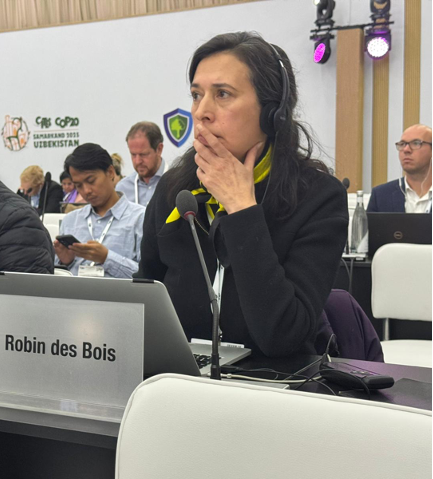 Charlotte Nithart seconds before the frog vote © DR
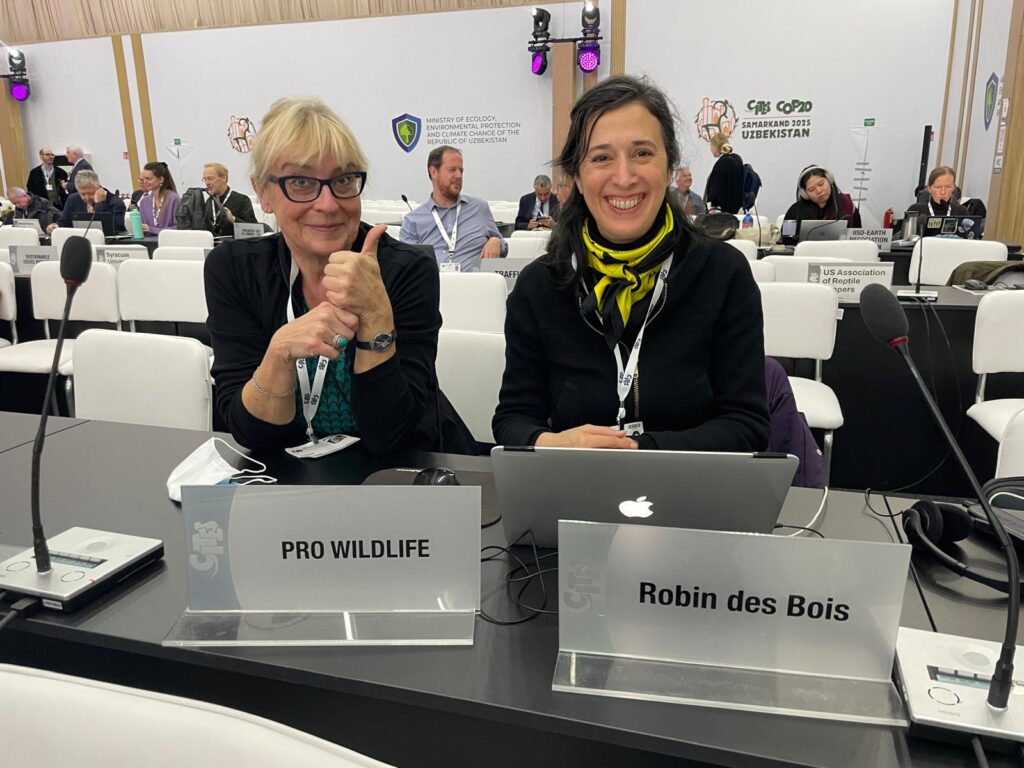 Sandra Altherr and Charlotte Nithart are happy. Their plea has paid off. © DR
The proposal by the European Union, North Macedonia and Israel to list the 4 species of aquatic frogs of the genus Pelophylax (Pelophylax epeiroticus, Pelophylax ridibundus, Pelophylax shqipericus and Pelophylax lessonae) in Appendix II of CITES has just been accepted by 92 votes in favour, 21 against and 26 abstentions. This is the first time that a historic stronghold of French culture and European gastronomy has been caught up in the vigilance surrounding endangered species. Türkiye, the main exporter of Pelophylax to the European Union, voted in favour. Indonesia abstained. The 21 countries that voted against, including China, Russia, Norway and the United Kingdom took on board the arguments of TRAFFIC and the IUCN (International Union for Conservation of Nature), which highlighted the lack of available data on the frog species traded but their voices were swept away.
The frogs thank the NGOs Pro Wildlife (Germany) and Robin des Bois (France) for patiently knitting this safety net.
This listing in Appendix II will come into effect after a delay of 18 months, the time for customs authorities to equip themselves with identification tools. Currently, the market is out of control and consumers rarely know what species they are eating and where they come from. Fraudulent labelling is widespread.
Frogs around the world are natural insecticides. They are much more useful in marshes than on plates.
See all Robin des Bois publications on CITES CoP20 in Uzbekistan
 Imprimer cet article